Transmission Spectrum Basics
The atmospheric components from Temperature, pressure, and chemistry are now ready to be turned into a spectrum. This notebook assembles the first complete forward model in the series: a transmission geometry, where starlight grazes the planet’s limb and the wavelength-dependent opacity of the atmosphere stamps its signature onto the light. Emission spectrum basics works through the same steps for emission, and Cloud models and Contribution analysis extend this setup further.
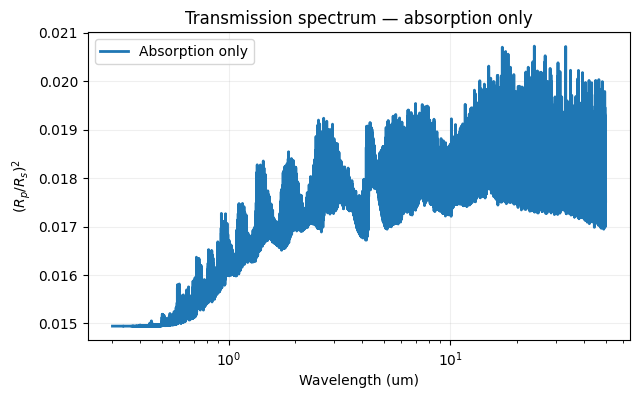
In transmission, the effective area blocked by the planet at each wavelength depends on how high in the atmosphere the gas becomes optically thick. Wavelengths that overlap with strong molecular absorption bands probe higher, cooler layers and show a larger transit depth.
This notebook builds a TransmissionModel step by step and then shows how adding radiative contributions — molecular absorption first, then CIA and Rayleigh scattering — reshapes the spectrum. More information about forward models is here, planet parameters are here, and star parameters are here.
Data Note
This notebook uses the opacity and CIA files set up in Setup and opacity data. TauREx provides the software to work with these datasets; the files themselves are third-party products from ExoMol and HITRAN.
[1]:
from _shared import build_base_components
from taurex.constants import RSOL

context = build_base_components(download=False)
iso_t = context['iso_t']
press = context['press']
chemistry = context['chemistry']
planet = context['planet']
star = context['star']

print(f'Planet: {planet.mass:.2f} M_jup, {planet.radius:.2f} R_jup')
print(f'Star: {star.temperature:.0f} K, {star.radius / RSOL:.2f} R_sun')
Planet: 0.74 M_jup, 1.38 R_jup
Star: 6117 K, 1.16 R_sun
Building the Model
Assembling a TransmissionModel connects the atmosphere from Temperature, pressure, and chemistry with a planet and a host star. Each physical process — molecular absorption, CIA, Rayleigh scattering, clouds — is added as an independent contribution object, which keeps the code composable and easy to extend.
The model must be explicitly build()-ed before running. Calling build() again after adding or removing a contribution refreshes the radiative-transfer kernel. More information about forward models is here, planet parameters are here, and star parameters are here.
[2]:
from taurex.model import TransmissionModel
from taurex.contributions import AbsorptionContribution

tm = TransmissionModel(
    planet=planet,
    temperature_profile=iso_t,
    chemistry=chemistry,
    star=star,
    pressure_profile=press,
)
tm.add_contribution(AbsorptionContribution())
tm.build()

print('Contributions:', [c.name for c in tm.contribution_list])
Contributions: ['Absorption']
[3]:
wngrid, rprs, tau, _ = tm.model()
wlgrid = 10000 / wngrid[::-1]
abs_only_rprs = rprs[::-1]

print(f'Computed {len(wngrid)} spectral points.')
print(f'Wavelength range: {wlgrid.min():.3f} to {wlgrid.max():.3f} um')
Computed 76744 spectral points.
Wavelength range: 0.300 to 50.002 um
[4]:
import matplotlib.pyplot as plt

plt.figure(figsize=(7, 4))
plt.plot(wlgrid, abs_only_rprs, lw=2, label='Absorption only')
plt.xscale('log')
plt.xlabel('Wavelength (um)')
plt.ylabel('$(R_p/R_s)^2$')
plt.title('Transmission spectrum — absorption only')
plt.legend()
plt.grid(alpha=0.2)
CIA and Rayleigh Scattering
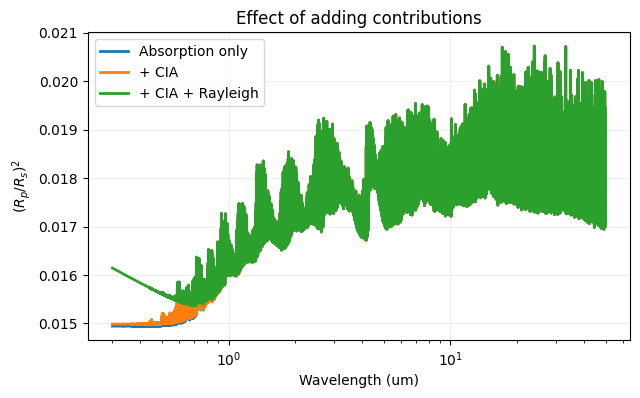
With absorption-only features in place, two more fundamental processes fill in the spectral baseline. Collision-Induced Absorption (CIA) from H₂–H₂ and H₂–He pairs adds a smooth continuum at long wavelengths, while Rayleigh scattering raises the transit depth in the blue. Each is added as a separate contribution and the model is rebuilt to register it.
Cloud models extends this model with cloud opacities. More information about available contributions is here.
Composite transmission regions
TauREx now includes the former taurex-multimodel plugin directly in core. If you need a transmission spectrum built from multiple 1D regions, use model_type = multi_transit in a parameter file and provide one regional parameter file per atmosphere in parfiles. The optional fractions list sets the weighting of each region, and the last fraction can be inferred automatically by providing only N-1 values.
[5]:
from taurex.cache import CIACache
from taurex.contributions import CIAContribution, RayleighContribution
from _shared import CIA_DIR, TMP_DIR

clean_cia_dir = TMP_DIR / 'cia_clean'
clean_cia_dir.mkdir(parents=True, exist_ok=True)

for source_path in CIA_DIR.glob('*.cia'):
    cleaned = [
        f"H2-H2 {line.split(maxsplit=3)[-1]}"
        if line.lstrip().startswith('eq-H2 -- eq-H2')
        else line
        for line in source_path.read_text().splitlines(keepends=True)
    ]
    (clean_cia_dir / source_path.name).write_text(''.join(cleaned))

cia_cache = CIACache()
cia_cache.cia_dict.clear()
cia_cache.set_cia_path(str(clean_cia_dir))

# Keep the cell rerunnable by starting from absorption only.
tm.contribution_list = tm.contribution_list[:1]

spectra = {}
for contribution, key in [
    (CIAContribution(cia_pairs=['H2-H2', 'H2-He']), 'cia'),
    (RayleighContribution(), 'full'),
]:
    tm.add_contribution(contribution)
    tm.build()
    spectra[key] = tm.model()[1][::-1]

rprs_cia = spectra['cia']
rprs_full = spectra['full']

print('Contributions:', [c.name for c in tm.contribution_list])
Contributions: ['Absorption', 'CIA', 'Rayleigh']
[6]:
plt.figure(figsize=(7, 4))
plt.plot(wlgrid, abs_only_rprs, lw=2, label='Absorption only')
plt.plot(wlgrid, rprs_cia, lw=2, label='+ CIA')
plt.plot(wlgrid, rprs_full, lw=2, label='+ CIA + Rayleigh')
plt.xscale('log')
plt.xlabel('Wavelength (um)')
plt.ylabel('$(R_p/R_s)^2$')
plt.title('Effect of adding contributions')
plt.legend()
plt.grid(alpha=0.2)
Reading the Spectrum
Each point on the transit-depth curve encodes the altitude at which the atmosphere becomes opaque at that wavelength. A higher transit depth means the planet is blocking a larger cross-section of the stellar disc — typically because a strong absorber is present at altitude.
Molecular absorption produces the narrow, prominent features: peaks at wavelengths where individual gases absorb strongly.
CIA adds a smooth continuum offset, most noticeable at the red end of the spectrum.
Rayleigh scattering lifts the spectrum at short wavelengths, producing a characteristic blue slope.